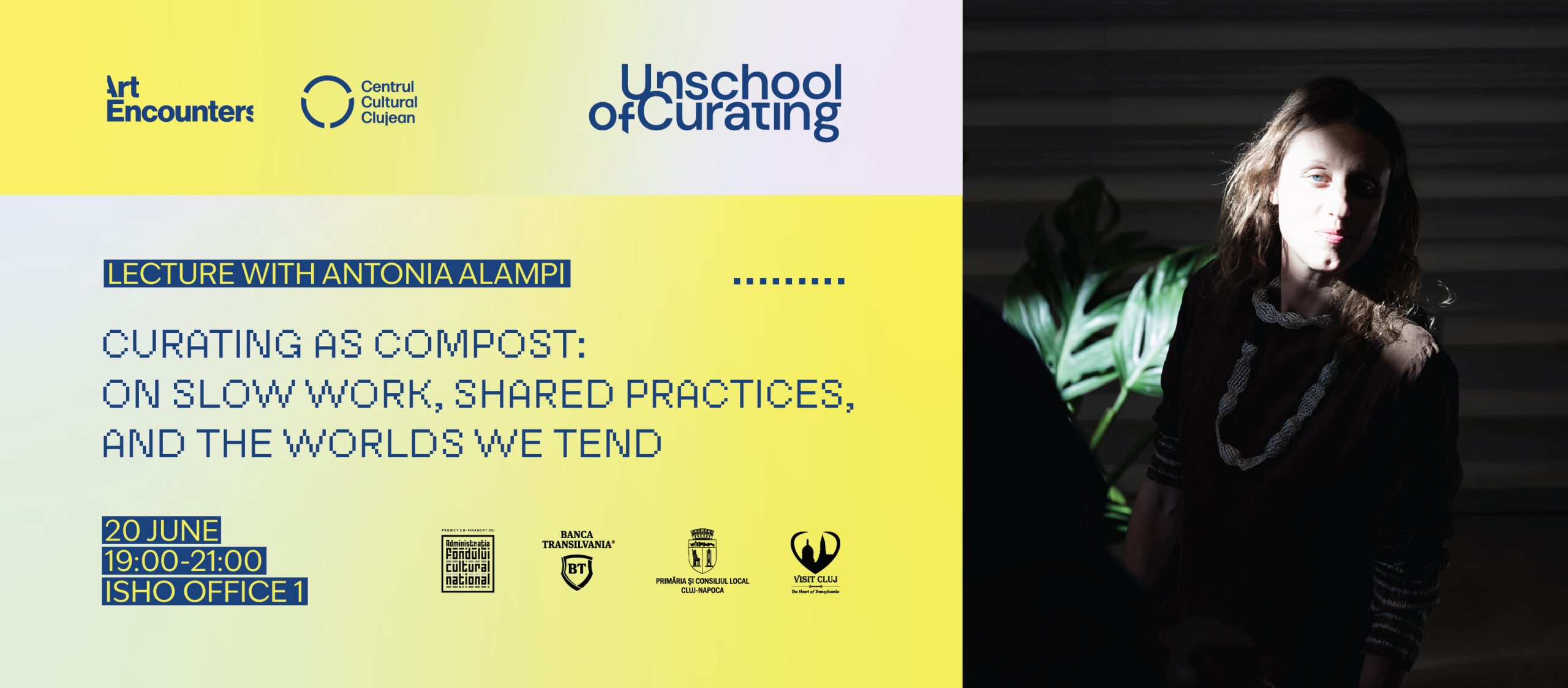
In this lecture, curator and Director of Spore Initiative – 𝗔𝗻𝘁𝗼𝗻𝗶𝗮 𝗔𝗹𝗮𝗺𝗽𝗶, reflects on curatorial practice as a process of cultivating relationships, infrastructures, pedagogies, and shared cultural ecologies over time.
Drawing from long-term collaborations developed through Spore Initiative and previous curatorial work, the lecture explores methodologies grounded in duration, reciprocity, situated knowledge, and collective responsibility. Central to this approach is the development of shared practices: ways of working that shape how institutions relate to communities, circulate resources, build alliances, organize attention, and sustain cultural life beyond the temporality of exhibitions alone.
Using compost as both metaphor and methodology, Alampi reflects on curatorial work as an accumulative and transformative process shaped through maintenance, coexistence, negotiation, transmission, and interdependence. Particular attention is given to collaborations with initiatives across the global majority, where cultural work often emerges through ancestral knowledge, land-based practices, pedagogical exchange, and community infrastructures that challenge dominant institutional rhythms and hierarchies.
Moving across questions of environmental justice, institutional transformation, pedagogy, visibility, and collective organization, the lecture examines how cultural institutions actively shape social and cultural ecologies through their economies, temporalities, partnerships, and modes of engagement.
At the center of the talk is an ongoing reflection on how institutions can develop methodologies that remain accountable to the contexts they engage, contribute to existing cultural and social ecosystems, and sustain forms of collective life, memory, and practice across time.
The event will mark the opening of the eighth edition of the 𝗨𝗻𝘀𝗰𝗵𝗼𝗼𝗹 𝗼𝗳 𝗖𝘂𝗿𝗮𝘁𝗶𝗻𝗴, developed collaboratively by Art Encounters Foundation and Cluj Cultural Centre, taking place in Timișoara and Cluj, Romania between June 19–26, 2026.
____
Antonia Alampi is a curator and cultural organizer from Southern Italy, based in Berlin. She is the founding Artistic Director of Spore Initiative, a platform exploring cultural practices and knowledge systems rooted in eco-social justice, community collaboration, and intergenerational learning.
Her work moves between exhibitions, public and educational programs, and long-term collaborations with practitioners from different fields. Often working within small-scale, socially engaged institutions, her practice reflects on how cultural work can support shared forms of knowledge, strengthen cultural ecologies, and cultivate relationships between communities and the environments we inhabit.
She previously served as Artistic Co-Director of SAVVY Contemporary in Berlin (2016–2020), was part of the curatorial team of sonsbeek20→24, and held curatorial positions at Extra City Kunsthal in Antwerp (2017–2019) and Beirut in Cairo (2012–2015). She also co-founded collaborative initiatives such as Future Climates and Toxic Commons, bringing together cultural practitioners and scientists to address environmental injustice and the politics of toxicity.
Across these contexts, her work explores how cultural institutions can be shaped as spaces for collective learning, ecological thinking, and the slow work of repairing cultural relations.
____
____
The Unschool is developed collaboratively by Art Encounters Foundation and Cluj Cultural Centre and takes place in Timișoara and Cluj, Romania between June 19–26, 2026. The programme aims to strengthen curatorial networks in Romania and internationally by focusing on informal methodologies, alternative pedagogies, and practice-led curatorial discourse. Its 8th edition, led by renowned curator Antonia Alampi, offers emerging curators an international platform for dialogue, knowledge exchange, and learning around the theme Repair as Method.
____
The project is co-financed by the Administration of the National Cultural Fund. The project does not necessarily represent the position of the National Cultural Fund Administration. AFCN is not responsible for the content of the project or how the results of the project may be used. These are entirely the responsibility of the beneficiary of the funding.
Project supported by Cluj-Napoca City Hall and City Council.
Strategic Partner: Banca Transilvania.
____
The project is co-financed by the Administration of the National Cultural Fund. The project does not necessarily represent the position of the National Cultural Fund Administration. AFCN is not responsible for the content of the project or how the results of the project may be used. These are entirely the responsibility of the beneficiary of the funding.
Project supported by Cluj-Napoca City Hall and City Council.
Strategic Partner: Banca Transilvania.