

Applications closed
Results: May 4, 2026
Unschool of Curating #8
Repair as Method
Course leader: Antonia Alampi
Unschool of Curating #8
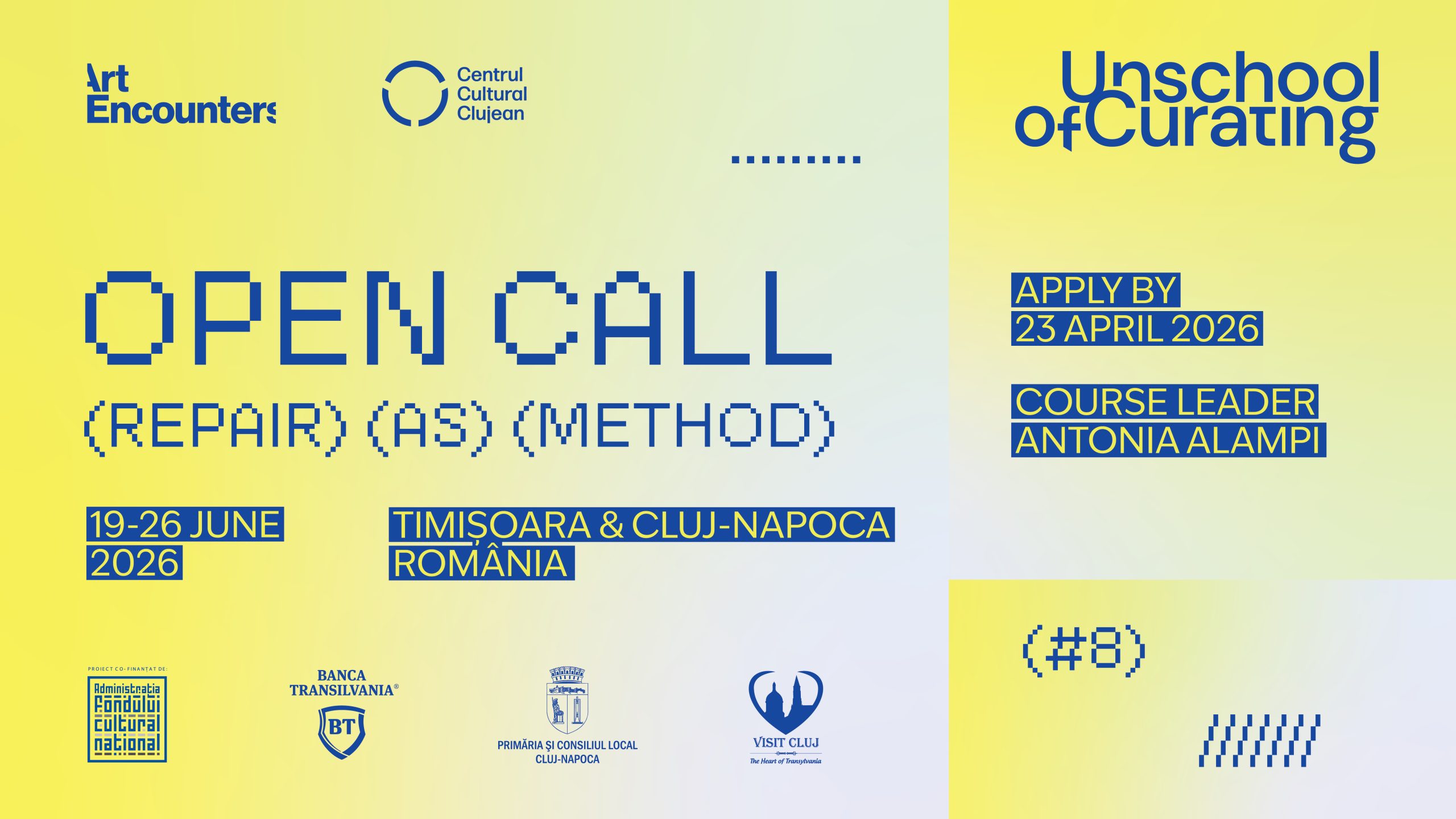
Art Encounters Foundation and Cluj Cultural Centre are launching the open call for the Unschool of Curating, taking place in Timișoara and Cluj, Romania between 19 – 26 June, 2026. The programme — developed collaboratively by the two organizations — aims to strengthen curatorial networks in Romania and internationally. The Unschool of Curating focuses on informal methodologies, alternative pedagogies, and practice-led curatorial discourse.
Its 8th edition, led by renowned curator Antonia Alampi, offers emerging curators an international platform for dialogue, knowledge exchange, and learning. Over the course of the program the participants will be immersed in the artistic context that both cities have to offer while exploring concepts and conversations around the theme Repair as Method:
This edition proposes “repair” not as a moral slogan but as a working method for curatorial practice.
In a cultural landscape shaped by acceleration, fragmentation, precarity, and asymmetrical access to resources, curating often risks reproducing the very dynamics it seeks to critique. Extraction of context. Instrumentalization of communities. Reinvention for the sake of visibility. Exhaustion disguised as productivity.
This edition of the Unschool asks: what would it mean to approach curatorial work as an act of repair?
Repair of relations between institutions and communities.
Repair of cultural memory and its silences.
Repair of communal life fractured by individualization.
Repair of methodologies that consume more than they contribute.
Repair does not mean reconciliation without tension. It does not deny difference, historical injustice, or structural power. Instead, it insists on working within these realities consciously — designing processes that are slower, more accountable, less extractive, and rooted in existing ecologies rather than imposed frameworks.
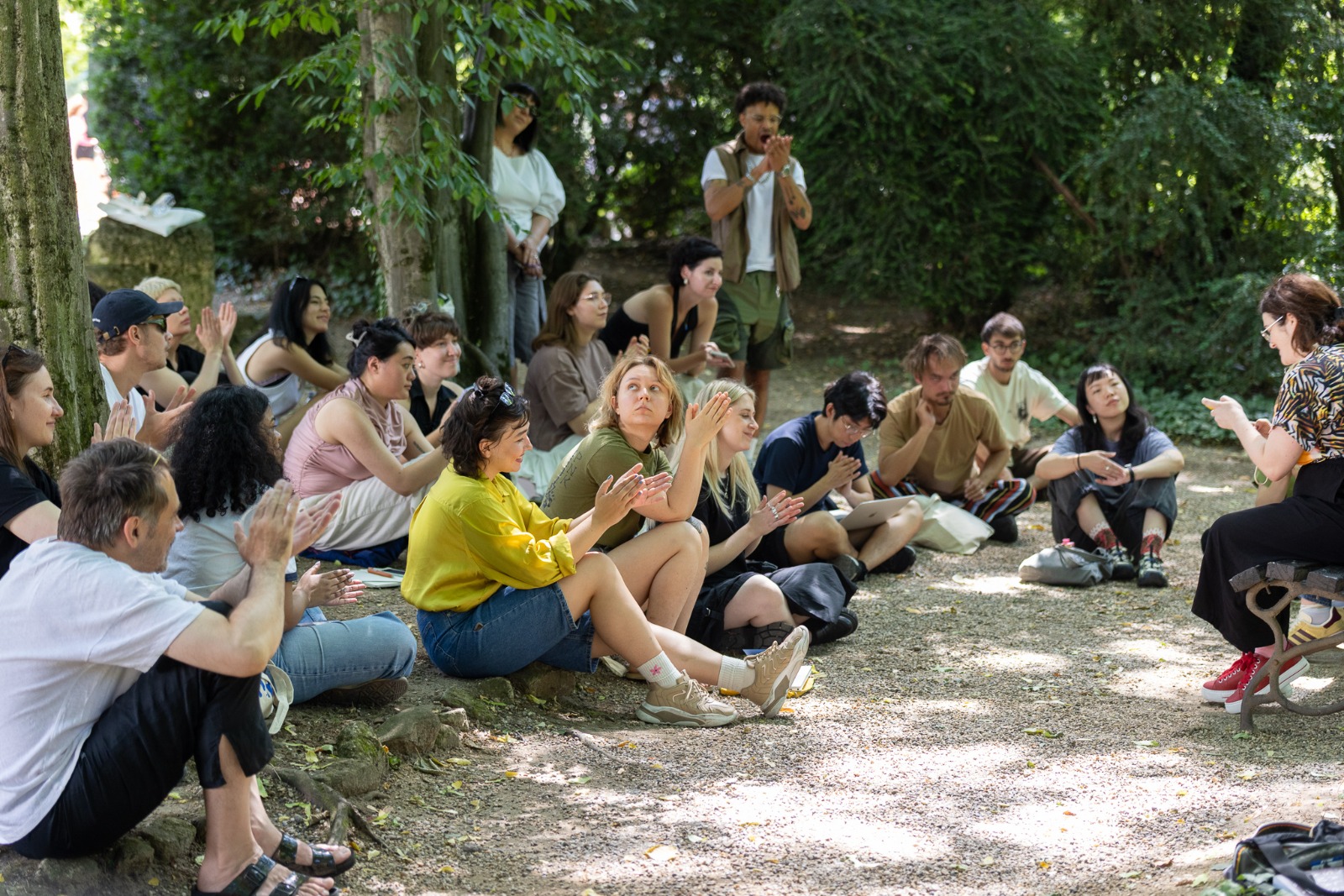
The week will combine keynotes, embodied practices, collective cooking, contextual grounding, visits and conversations, and peer-to-peer organised group exchange. Romania is not treated as a theme but as a situated context: a place whose specific histories, transitions, and cultural infrastructures will inform the discussions without being reduced to case study.
Participants and contributors alike — local and international — will engage in an intensive laboratory exploring how curatorial work can move from spectacle toward maintenance, from authorship toward relation, from novelty toward responsibility.
Programme
The programme of the Unschool of Curating is split between four days in Timișoara (19-23 June, 2026) and four days in Cluj (23-26 June, 2026) and includes lectures and working sessions with the course leader, presentations and workshops with Romanian and international guest speakers, visits to local galleries, art venues and exhibitions, and meetings with curators and artists. Two public events are organized as part of the programme – a public lecture of the course leader in Timișoara and an open conversation with participants in Cluj.
Course leader: Antonia Alampi
Antonia Alampi is a curator and cultural organizer from Southern Italy, based in Berlin. She is the founding Artistic Director of Spore Initiative, a platform exploring cultural practices and knowledge systems rooted in eco-social justice, community collaboration, and intergenerational learning.
Her work moves between exhibitions, public and educational programs, and long-term collaborations with practitioners from different fields. Often working within small-scale, socially engaged institutions, her practice reflects on how cultural work can support shared forms of knowledge, strengthen cultural ecologies, and cultivate relationships between communities and the environments we inhabit.
She previously served as Artistic Co-Director of SAVVY Contemporary in Berlin (2016–2020), was part of the curatorial team of sonsbeek20→24, and held curatorial positions at Extra City Kunsthal in Antwerp (2017–2019) and Beirut in Cairo (2012–2015). She also co-founded collaborative initiatives such as Future Climates and Toxic Commons, bringing together cultural practitioners and scientists to address environmental injustice and the politics of toxicity.
Across these contexts, her work explores how cultural institutions can be shaped as spaces for collective learning, ecological thinking, and the slow work of repairing cultural relations.
Speakers of the Edition
Curatorial practices between collective learning and repair
This year’s edition, Repair as Method, brings together Alessandra Pomarico, Amal Alhaag, Maria Sârbu, Raluca Voinea, and Szekely Sebestyen Gyorgyi, a group of curators, researchers, and practitioners whose work unfolds at the intersection of curating, pedagogy, and socially engaged practices.
Working across different contexts, they engage with questions of collective learning, knowledge production, community building, and alternative institutional frameworks. Their contributions open up spaces for dialogue, exchange, and critical reflection in relation to the idea of curating as an act of repair.
As part of Unschool of Curating #8, they will take part through lectures, workshops, and conversations, contributing to a shared learning process shaped by the artistic and social contexts of Timișoara and Cluj.
Speakers
Alessandra Pomarico
Alessandra Pomarico is an independent curator, writer, educator, and organiser working across art, pedagogy, and community-building. She is the founder of Free Home University and Sound Res, and a co-initiator of the Ecoversities Alliance network. Her work engages with communities, land-based practices, and alternative forms of knowledge production. She focuses on relational and pluriversal epistemologies within the Ecology of Care framework. She currently teaches Art Pedagogy at the Fine Art School of Bari.
Amal Alhaag
Amal Alhaag is a curator, cultural organiser, and researcher based in Amsterdam. Her work unfolds through long- and short-term collaborations with artists, collectives, and institutions. She is co-initiator and facilitator of platforms such as Metro54, The Side Room, Sustaining the Otherwise, and The Anarchist Citizenship. Her practice focuses on interdisciplinary and collaborative approaches to cultural production.
Maria Sârbu
Maria Sârbu is an art historian, critic, curator, and educator based in Timișoara. She is a lecturer at the Faculty of Arts and Design at the West University of Timișoara, where she teaches contemporary art and curating. Her research focuses on post-1989 Romanian art within the Eastern European context. She is the author of several books and has curated projects with the Avantpost group and through the DRAFT curatorial program. Her work also includes cultural mediation and public engagement with contemporary art.
Raluca Voinea
Raluca Voinea is a curator and art critic based in Bucharest. She is co-director of tranzit.ro and part of the tranzit.org network of cultural organisations in Central and Eastern Europe. She previously managed the tranzit.ro Bucharest space and now contributes to The Experimental Station for Research on Art and Life. Between 2008 and 2024, she was co-editor of IDEA. Arts + Society magazine. She is also co-founder of The Resurrection Committee, a curatorial research initiative.
Szekely Sebestyen Gyorgyi
Sebestyén Székely is an art historian, curator, and gallerist based in Cluj. His work combines historical research with interdisciplinary approaches to modern and contemporary art. He is the founder of Galeria Quadro and a co-founder of Fabrica de Pensule and Aluvial Project Space. His projects often explore themes such as identity, multiculturalism, and ecology. He has conducted research internationally and published extensively on modern and contemporary artists.