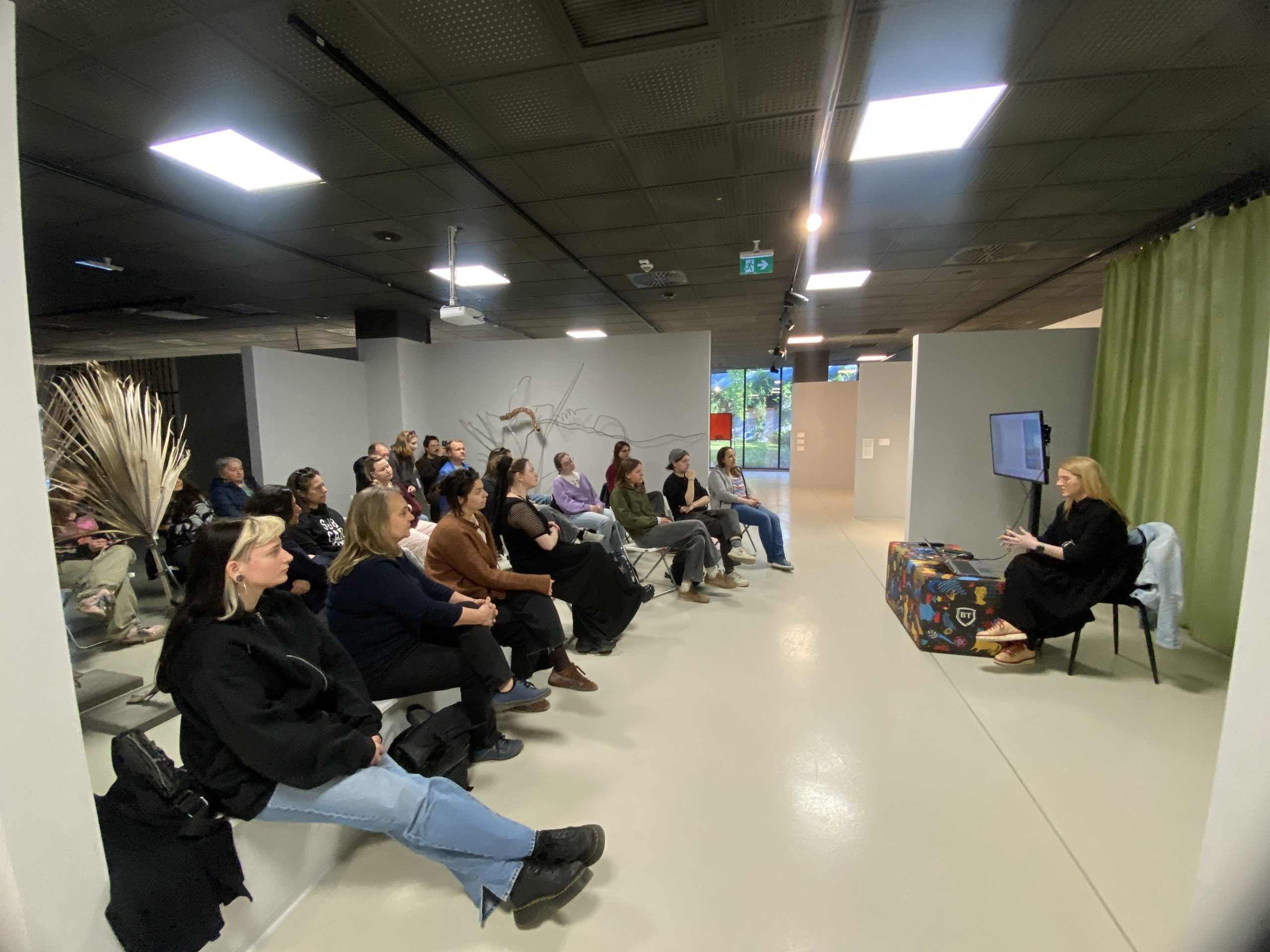
We invite you to “Close Encounters with Contemporary Art” with Maria Sârbu, an open course inspired by two solo exhibitions: Nona Inescu: Afterlife – Still Life and Oláh Gyárfás: The Broken Corner of the Cube.
The sessions offer an accessible introduction to the themes and directions of the two exhibitions, exploring how the works address the relationship between the body, matter, and the environment. The discussions highlight perspectives on nature, materiality, and forms of hybridity, opening up a framework of interpretation that links contemporary artistic practices to questions of time, transformation, and coexistence.
Starting from the exhibited works, the course invites participants to explore different ways of understanding contemporary art, through dialogue and concrete examples, in an open and friendly format.
📍 ISHO Office 1, Timișoara
📅 April 30, 2026, 6:00 PM
Maria Sârbu is a lecturer in the Faculty of Arts and Design in Timișoara, specializing in art history and theory. She studied at Babeș-Bolyai University in Cluj-Napoca, where she developed her research on post-communist Romanian art. She has been collaborating with the Art Encounters Foundation since 2017 and is the author of the book “Art Guide: An Introduction to Contemporary Romanian Art.” Her curatorial work includes projects carried out in collaboration with the Avantpost group, as well as the launch of the DRAFT curatorial program. Alongside her academic work, she develops cultural mediation formats designed to familiarize the public with contemporary art.
___
Free entry.
___
The exhibitions and events program are part of the “Three-Headed Plants” project, co-funded by AFCN and supported by a strategic partnership with Banca Transilvania, Catena—exhibition partner, Ploom—events partner, and ISHO. The project is carried out in partnership with: UVT Arte, UVT FLIFT, Catinca Tăbăcaru Gallery, Sector 1 Gallery.
This project does not necessarily represent the position of the National Cultural Fund Administration. AFCN is not responsible for the content of the project or for how its results may be used. These are entirely the responsibility of the grant recipient.